What is factoring with an example?
Table des matières

- What is factoring with an example?
- What does factoring mean in finance?
- What does factoring do for us?
- What is factoring and its process?
- How would you describe factoring?
- What is a polynomial factor?
- What is a factoring agreement?
- How do you understand factoring?
- Is factoring short or long term?
- How do you figure out factoring?
- What are the three methods of factoring?
- What does factoring mean?
- What is the purpose of factoring?
- How is factoring different from a business loan?
What is factoring with an example?
In algebra, 'factoring' (UK: factorising) is the process of finding a number's factors. For example, in the equation 2 x 3 = 6, the numbers two and three are factors. ... “[Factoring] is selling your invoices to a factoring company. You get cash quickly, and don't have to collect the debt.”
What does factoring mean in finance?
Factoring allows a business to obtain immediate capital or money based on the future income attributed to a particular amount due on an account receivable or a business invoice. Accounts receivables represent money owed to the company from its customers for sales made on credit.
What does factoring do for us?
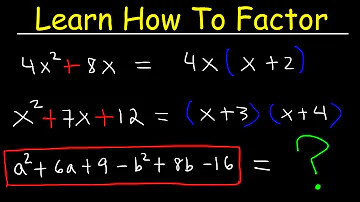
Factoring: Finding what to multiply together to get an expression. ... It is like "splitting" an expression into a multiplication of simpler expressions.
What is factoring and its process?
Factoring is a financial service in which the business entity sells its bill receivables to a third party at a discount in order to raise funds. ... Factoring involves the selling of all the accounts receivable to an outside agency. Such an agency is called a factor.
How would you describe factoring?
Factoring is a financial transaction and a type of debtor finance in which a business sells its accounts receivable (i.e., invoices) to a third party (called a factor) at a discount. A business will sometimes factor its receivable assets to meet its present and immediate cash needs.
What is a polynomial factor?
A factor of polynomial P(x) is any polynomial which divides evenly into P(x). For example, x + 2 is a factor of the polynomial x2 – 4. The factorization of a polynomial is its representation as a product its factors.
What is a factoring agreement?
A factoring agreement is a financial contract that details the full costs and terms of purchasing a business's outstanding invoices. When a business and a factoring company decide to start the invoice factoring process, they enter a factoring agreement.
How do you understand factoring?
1:508:33Whiteboard Math: The Basics of Factoring - YouTubeYouTube
Is factoring short or long term?
Factoring is a short-term solution; most companies factor for two years or less. Plant says the factor's role is to help clients make the transition to traditional financing.
How do you figure out factoring?
The invoice factoring rate is calculated by multiplying the factoring rate, which can range from 0.55% to 2%. In this example, the rate is 1.5% of $100,000 x 12 months = $18,000.
What are the three methods of factoring?
- Methods of Factoring Common factor. In an expression composed of multiple terms, try to identify if there is one number/variable that is a common factor to each term. Difference of squares. ... Difference of cubes / Sum of cubes. ... Grouping. ... Trial and Error. ...
What does factoring mean?
- Factoring is a financial transaction whereby a business sells its accounts receivable to a third party at a discount.
What is the purpose of factoring?
- Factoring is a common mathematical process used to break down the factors, or numbers, that multiply together to form another number. Some numbers have multiple factors. The number 24, for instance, results when you multiply the factors of 6 and 4, 8 and 3, 12 and 2, and 24 and 1. Factoring is useful in resolving various numbers-related problems.
How is factoring different from a business loan?
- Factoring is not a business loan - it's the sale of an asset (the invoice). Essentially, the factor is purchasing the right to collect on an invoice when it's paid, minus a discount of 2 to 6%. Essentially, the factor is purchasing the right to collect on an invoice when it's paid, minus a discount of 2 to 6%.