What is the crop factor of APS-C?
Table des matières

- What is the crop factor of APS-C?
- Is APS-C enough?
- What is Sony APS-C?
- Is APS-C better than 1 inch?
- What is normal lens for APS-C?
- What is 28mm on APS-C?
- Do professional photographers use APS-C cameras?
- Is it OK to use full-frame lenses with APS-C cameras?
- How do I use my Sony APS-C camera?
- What is APS-C and full frame?
- What is an APSC sensor?
- What is APS C camera?
- What is an APS sensor?
- What is an APS camera?
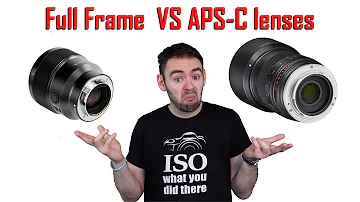
What is the crop factor of APS-C?
A standard APS-C sensor (Fuji, Sony, Nikon DX) has a 1.5x crop factor, meaning if you divide the diagonal length of a full frame sensor by that of an APS-C sensor, you get about 1.5 (Micro Four Thirds has a 2x crop factor).
Is APS-C enough?
Yes and no. In terms of low-light capability, dynamic range, and image quality yes, but in terms of cost, weight, and sizes, APS-C takes the cake with its more compact camera body, less heavy glasses required in their lenses, and since there is less component, they are way cheaper than their full frame counterparts.
What is Sony APS-C?
The APS-C size capture function allows images to be recorded using only the area at the center of the screen that corresponds to the size of an APS-C sensor. It provides the following benefits: It acts as a simple teleconverter.
Is APS-C better than 1 inch?
In comparison to full a frame sensor, a pocket camera's 1/2.5-inch Type sensor crops the light gathering surface 6.0 times smaller diagonally, or 35 times smaller in area. An APS-C size sensor gathers about 15 times more light (area) than a 1/2.5” Type sensor and 2.4 times less than full frame.
What is normal lens for APS-C?
Film still
| Film format | Image dimensions | Normal lens focal length |
|---|---|---|
| APS C | 16.7 × 25.1 mm | 28 mm, 30 mm |
| 135, 35mm | 24 × 36 mm | 40 mm, 50 mm, 55 mm |
| 120/220, 6 × 4.5 (645) | 56 × 42 mm | 75 mm |
| 120/220, 6 × 6 | 56 × 56 mm | 80 mm |
What is 28mm on APS-C?
A 28mm f/2 lens on APS-C is only theoretically equivalent to 42mm f/3 on full frame as far as angle of view and depth of field are concerned. It is equivalent to a 42mm f/2 as far as exposure (shutter speed, aperture and ISO) are concerned. Consequently, there is really no such thing as an equivalent aperture per se.
Do professional photographers use APS-C cameras?
Personally I use 35mm and medium format cameras, having long since abandoned the Speed Graphic and 4 x 5. Not necessarily, professional bird and sports photographers mostly use APSC cameras because they get longer range using zoom lenses.
Is it OK to use full-frame lenses with APS-C cameras?
Can I Use a Full Frame E-Mount Lens (aka FE Lens) on a Camera with an APS-C Size Sensor? Yes, you can use an FE lens on an E-Mount camera that has an APS-C sensor. The image in the center of the lens is automatically cropped to the APS-C size, so there are no dark corners surrounding the picture to cause vignetting.
How do I use my Sony APS-C camera?
0:361:46How to turn on APS-C/Super 35 Mode for you Sony Alpha 7S III CameraYouTube
What is APS-C and full frame?
A full-frame lens is roughly equivalent to a 35mm frame of film, while an APS-C sensor is a little bit smaller. ... This means your camera's APS-C-size sensor magnifies the scene to produce an image that will match the lens's full-frame image circle.
What is an APSC sensor?
- Advanced Photo System type-C (APS-C) is an image sensor format approximately equivalent in size to the Advanced Photo System "classic" negatives of 25.1×16.7 mm, an aspect ratio of 3:2.
What is APS C camera?
- Nowadays most of photographer use the APS-C (APS-C stands for Advanced Photo System type C) camera to capture the photograph. The reason because full frame camera is more expensive, especially for digital SLR .
What is an APS sensor?
- Jump to navigation Jump to search. An active-pixel sensor (APS) is an image sensor where each picture element ("pixel") has a photodetector and an active amplifier.
What is an APS camera?
- An APS film camera is a camera that takes advantage of the Advanced Photo System™ procedure invented by the Eastman Kodak Company , in association with several other photography companies. The point was to introduce a new type of film and camera to the mass market that would be more user-friendly than anything up to that point.